March was incredibly productive for our club. We successfully approved changes to our by-laws. We had an enlightening discussion on the Guatemala Literacy Project (GLP), a large Rotary global grant project that has had a profound impact on literacy improvement thanks to the collective efforts of 800 Rotary clubs and 90 districts over the twenty-seven years. (www.guatemalliteracy.org). Emily Swisher, the GLP presenter sends this note,” Feeling grateful to Arden Hills-Shoreview club for such a warm welcome, important questions, and thoughtful discussion. It was an honor to present our project”. Her email describes how you can sponsor a student. I will share this email separately.
Excitingly, our club is poised to proposed TWO significant grant projects: 1) a global grant (~$60K) championed by Rotarian Don Martin for Liberia for providing necessary medical equipment and training for nurses to improve Ear and Hearing care, and 2) a district international grant ($28K) led by Rotarian Dave Newman for farmers in a Nicaragua community, that will directly connect small agriculture farmers with market, eliminate the middleman and thus realize the added value to their product, while potentially exporting a significant portion of their crops. The club will support both these projects by contributing the $3000 each, the remainder to be raised from other clubs and Rotary match grants.
What is commendable about these two proposals is that their potential to foster systemic and sustainable change with the respective communities. Reviewing the proposals, I couldn’t help but recall the teachings during my executive MBA of Prof Marshall Ganz of Harvard University. He emphasized that social change is catalyzed by purposeful individuals or organizations who respond to challenges, cultivate new relationships, and harness economic and cultural influence to drive action.
In the upcoming meeting, I will allocate time for Don and Dave to present their international projects. Thanks to Glenn Bower to encourage his committee members to think differently and propose these impactful projects.
As we continue to invite speakers to our club who shed light on pressing community needs like hunger, homelessness, literacy, and mental health, it is imperative that we delve deeper into the root causes of these issues. Our committees should serve as platforms for identifying these key issues, strategic planning, fostering collaboration, engaging community, and maximizing the potential of grants to enact lasting change.
We will be looking forward to a busy April planning and executing the Taste of Shoreview event, a fundraiser that will support the Slice of Shoreview event during summer. Please help Ken Hola by volunteering to help him conduct this event.
A heartfelt thank you to each of you for your unwavering efforts.
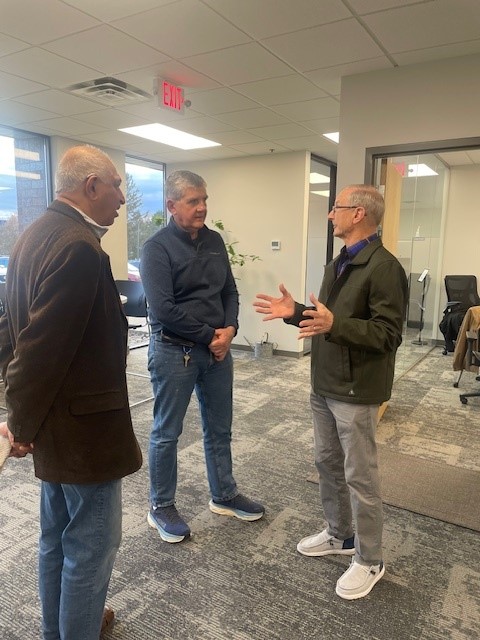
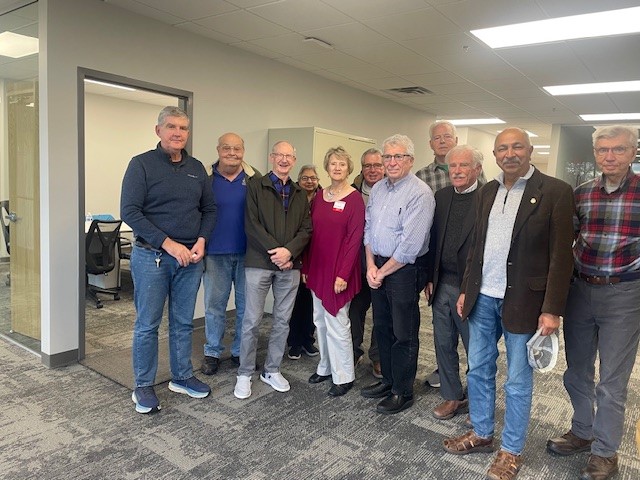
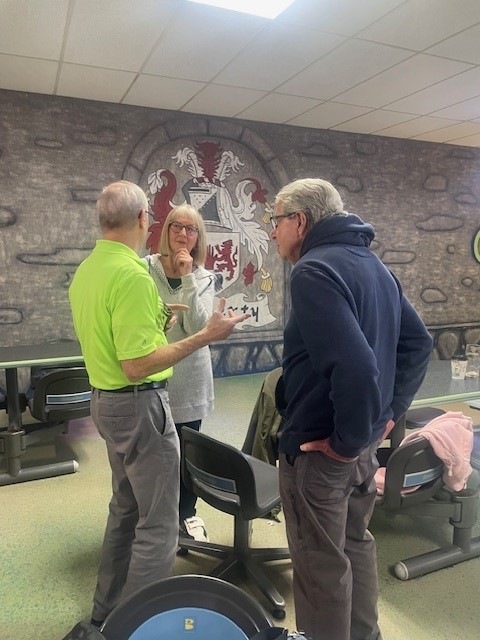
We had two club activities in November-a business tour to VivaQuant and bowling at Flaherty's. Mike Spellman is shown in the first photo doing a Rotary recruitment pitch to the CEO of VivaQuant. Our Ukrainian mom Svitlana works there. They make a patch-style remote cardiac monitors. The last photo shows Mike again with the Erno's discussing bowling strategy. This 'Strike Out Polio' event raised over $700 for the Foundation.
Members of the Membership Committee are busy meeting club members either for coffee, drinks, or a meal to learn more about each other and provide their thoughts on our club and what they like and don’t like. Everyone should have been contacted by now. Meetings will continue through October and we hope to be able to collate the data collected and have some good information on which to base future projects. We also hope that this will provide a means to become further connected with other members. If you haven’t been contacted about this by a club member, please contact Elinor Jackson and she will get the ball rolling for you!
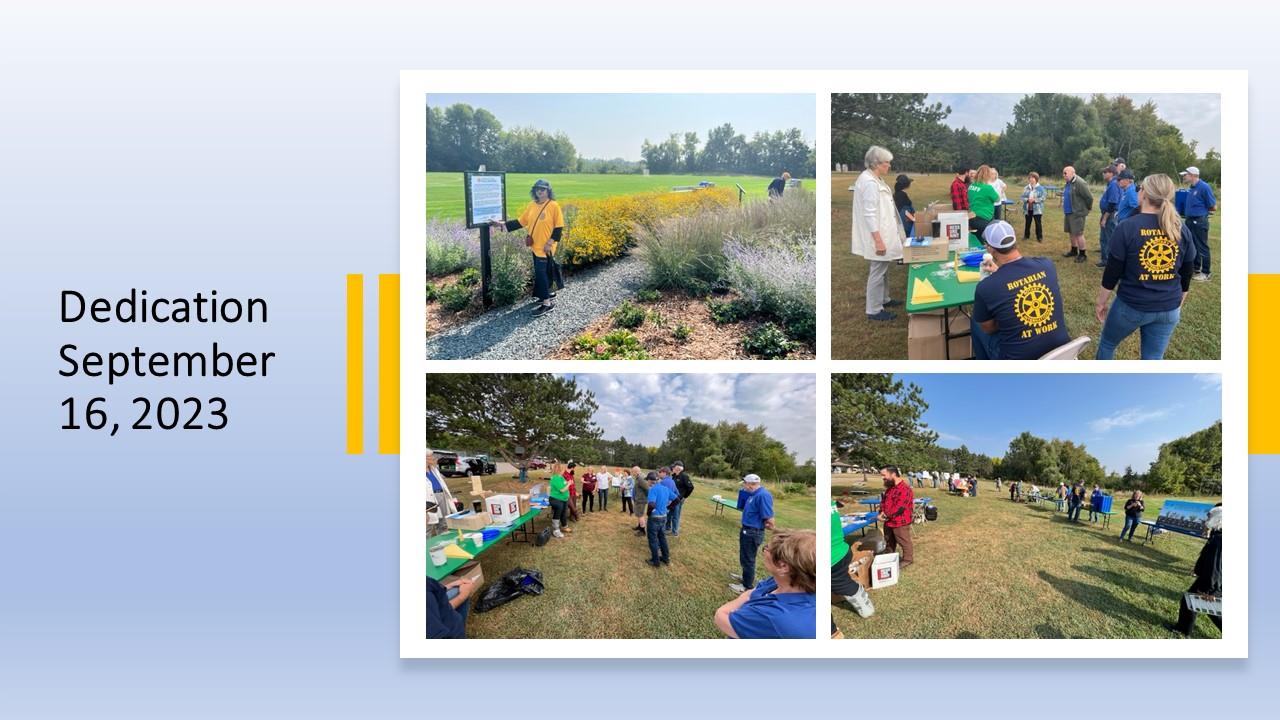
Thanks to all the club members and spouses that attended the Pollinator Garden dedication event on September 16’th.
In addition to the 100+ visitors during the event we had the Shoreview Garden Club, City of Shoreview Park and Recreation, the Rice Creek Watershed District , a Ramsey County Master Gardner, Landscape Alternatives, the Environmental Quality Commission and our club exhibiting. The city also provided several activities for kids to earn about pollinators and pollination.
Once again, our club is contributing to other club’s international service projects funded with a District Grant. This includes three projects in Africa and one in South America.
The Rotary Club of Prior Lake has a water filtration project in Chibolte, Peru which will help provide clean water to a refugee community. In addition, we are supporting two computer labs in Africa. One is the Elimisha Kakuma Technology Hub in Kenya, a project of the Lakeville club. This project will purchase equipment and build a technology hub that will serve students in a refugee camp. The other is a project of the Rotary Club of North St Paul/Maplewood/Oakdale at the Mbiriizi Advance Primary and Day Care School in Uganda, which is supported by Sylvia’s Children. The project will purchase computers, desks, and chairs for the creation of a computer lab for the students. The final project is a water project of the White Bear Lake club. This project will establish three borehole wells, one for each of three schools in the Iganga District of Uganda.
Over the next few months, we will hear directly from each of the clubs about their project. These presentations will be made at our regular Tuesday morning meetings. In addition, we will also hear about the progress made on each of the international projects we supported during the 2022-23 Rotary year.
One of the great joys of serving Rotary in the AG’s position is the opportunity the job presents to meet other club leaders and see what innovative things those clubs are doing. As I have often said, “Some of the best ideas I’ve ever had, I stole from someone else.” And I’m not backing down from that.
For example, while it was a modest beginning, the Elk River club did hold their first ever Lithium-Ion battery recycling event a few weeks ago, from which they gained valuable experience with the process of receiving the spent batteries and packaging them properly for shipment back to “Redwood Resources,” the company that Rotary has partnered with to offer this program. I went, just to see how it worked. If Elk River can do it, so can we. It’s not just the batteries, it’s “Rotary People of Action” in the community.
I had the privilege of attending the swearing-in ceremony for the new President of the Anoka club. It wasn’t an ordinary ceremony held during a regular club meeting. It was a picnic in a pavilion located in a lovely park near downtown Anoka with locals as well as club members attending...an enjoyable event that got their members out of their meeting format and into a public space. I’m also impressed by the social benefit Anoka enjoys by renting a bus for Rotarians and their friends to attend Twins games as a group, and any number of other fun-focused activities. Here is another club that goes places and does things.
In Cambridge-Isanti, which seems rather geographically isolated from the body of 5960 (they are about an hour north and west of where I live in Shoreview), I found a club that has, over the years, built a strong student exchange program, which has become the principal focus of their club. Beyond that, however, they have members who work to ship medical supplies to Ukraine. So, even a small club can accomplish big things.
Coon Rapids seems to have something going on all the time. In October, they will have what seems similar to our “Taste” event in the clubhouse of the city-owned Bunker Hills Golf Club. There, as in Elk River, the list of sponsors goes on and on, and sponsorships are understood by everyone to be the “key” to a successful event. There are lessons to be learned here. More than that, however, is a strong emphasis on “showing up” in the community in ways that maintain visibility. The latest example had club members on the front steps of the high school welcoming students to their first day of class. And finally, I attended a Coon Rapids Rotary “social” at a local bar which anyone could attend. Anything to “meet the people.”
Although they are not in my “AG Area,” so to speak, I’m learning right now about the Northfield club’s Sept. 8 Rotary Family Bike Tour, which involves hundreds of adults and children in a fun activity, while putting Rotary’s name out in the community and raising funds for the club. I know about this because I will be in Northfield on Sept. 21 to present an overview of Rotary’s new strategic partnership with the Institute for Economics and Peace. Watch for a Zoom invitation from Kathy Hughitt.
I hope during the course of this year, we can animate the “Explorers Team,” in our club, the point of which has, from the beginning, been to see and learn from other clubs. Right now, I believe, the “team” is just Anoop, Elinor, and me. Exploring is fun, whether by travelling or just by scouting the websites of other clubs. And it’s easy to sign up. So come on...surprise me. Join the Rotary Explorers Team.
Our speaker today was Alan Anderson from the Northfield Rotary Club. Alan's educational background is in wildlife sciences and he had a long career working for the Boy Scouts of America. He has long been an advocate for protecting our environment and his presentation was centered on this topic and the fact that it is now the 7th "Area of Focus" for Rotary International. He noted the fact that as far back as the 1980's, NASA scientists accurately predicted the rise in global temperatures we are now experiencing. Climate change is upon us and is largely due to an increase in CO2 emissions. It is irreversible. The last time average temperatures were as high as they now are was 3 million years ago. Although average temperatures have only increased about 1 degree in the past 30 years or so, that change is responsible for the the climate disasters we have been recently experiencing. Yet Anderson assured us that there is some good news. Most countries now agree and recognize the reality of climate change. And energy sources other than fossil fuels are becoming very available and costs are falling. He stressed that one of the most important things all of us can do to protect our environment from further damage is to begin talking about this subject with other people, rather than avoiding the subject, which many of us often do.
We were fortunate today to hear from Patricia Shafer, who was a Rotary Peace Scholar 10 years ago and is still working on global peace initiatives - now with the Institute for Economics and Peace.

.png)


.jpg?_=638482186827190594)



.JPG?_=638482186827191246)


